
“The Profit”
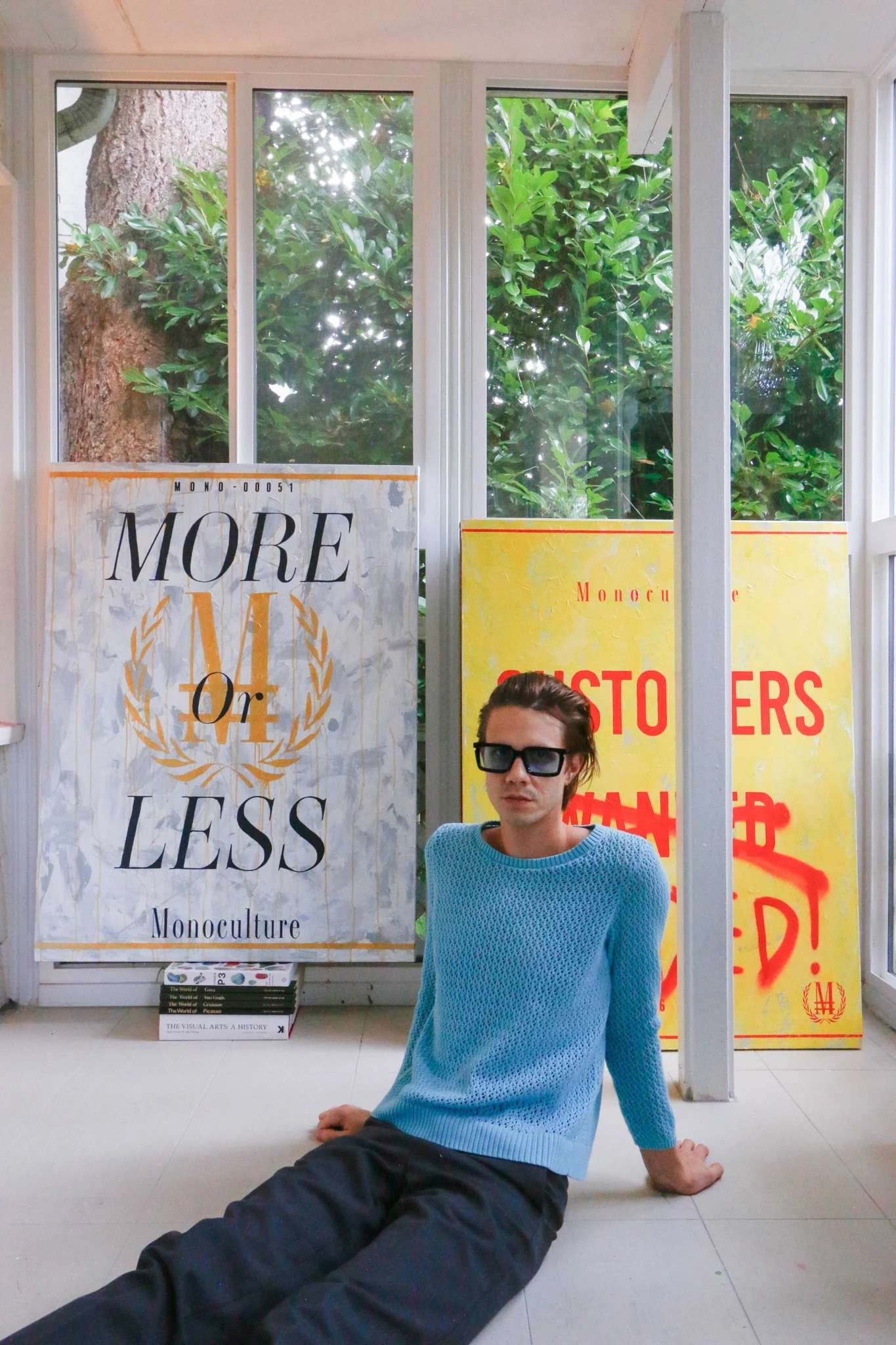
Monoculture is a value statement.
Every work of art is a value statement. As an artist, when you are making a piece, you are choosing something specific to depict and therefore saying it’s important enough for you to put the time and effort into depicting it. You are also choosing not to depict something - and everything - else. You’ve just created a hierarchy of value, which is, to some degree, also a moral and a political statement.
Monoculture is asserting itself as the logical conclusion of a culture that views the ultimate value of art (along with everything else) as being measured by its monetary worth. While, simultaneously, the work questions the very premise of the late-capitalist attitude which necessitates its existence.
By blurring the lines between art and more explicit commercial media like advertising imagery, product design, and fashion branding, Monoculture interrogates whether or not contemporary art can distinguish itself as having any cultural utility beyond its function as a commodity object.
Borrowing the visual language of the advertising agency, the work attempts to hijack their methodology while interrogating the conceptual assumptions underpinning it. While the aesthetics of the work reflect the branded, ad- driven, consumer landscape of late capitalism, the content of it – the text; the titles, slogans and catchphrases adorning the work – pry at the foundations of how we measure value.
Monoculture’s stylistic similarities, emulating commodity culture, make it easily recognizable and accessible to the casual observer, but in its discontinuities it attempts to disrupt the viewers presuppositions of both its existence as an object and the hierarchy of value underlying its production.